A Canadian Middle Ages? Shared National Identity and the Canadian National Collections

This March, the first-year Master’s of History students at Carleton University were invited to attend a workshop at Library and Archives Canada (LAC). Led by special collections librarian Meaghan Scanlon, the workshop featured a number of books from diverse acquisitions including (but not limited to) donations from the parliamentary library of Canada, gifts to Canada from the British government, and the private collections of Mackenzie King and other notable Canadian figures. The purpose of the collection is to preserve and provide access to rare works that are significant to Canadian history. Among the items that were shown were first editions of works by Lucy Maud Montgomery, a 1475 copy of Xenophon’s Cyropaedia formerly owned by Giorgio Antonio Vespucci (uncle of Amerigo Vespucci), William Dampier’s Nouveau voyage autour du monde, and Thomas Thomson’s A System of Chemistry of Inorganic Bodies donated to the LAC from the Molson family private collection (Fig. 1).

A System of Chemistry of Inorganic Bodies [Fore edge showing untrimmed pages] / A System of Chemistry of Inorganic Bodies [La gouttière montre que certaines pages n’ont pas été rognées]

Fig. 1: Library and Archives Canada, A System of Chemistry of Inorganic Bodies [Fore edge showing untrimmed pages], Click on image to learn more (redirects to the LAC’s Flickr).

Scanlon gave the class a crash course in codicology, or the study of books as objects, by first showing us the book binding method employed in the creation of incunables (early printed books). To demonstrate how they were bound in quires, she folded a large piece of paper to create eight pages or leaves. For clarity, the University of Michigan library illustrates this idea in a lesson titled “What is a Codex?”. We later discussed how books reveal their history through the damages, repairs, and markings they accumulate over time. For example, the three volumes that made up William Dampier’s travel books (Fig. 2) had a fair amount of fire damage from the 1952 fire that broke out in Canada’s legislative library. Furthermore, there is evidence of post-fire repairs by conservators. Both of these events in this book’s “life” are now a unique aspect of this particular book’s history and transcend its original purpose and contents.
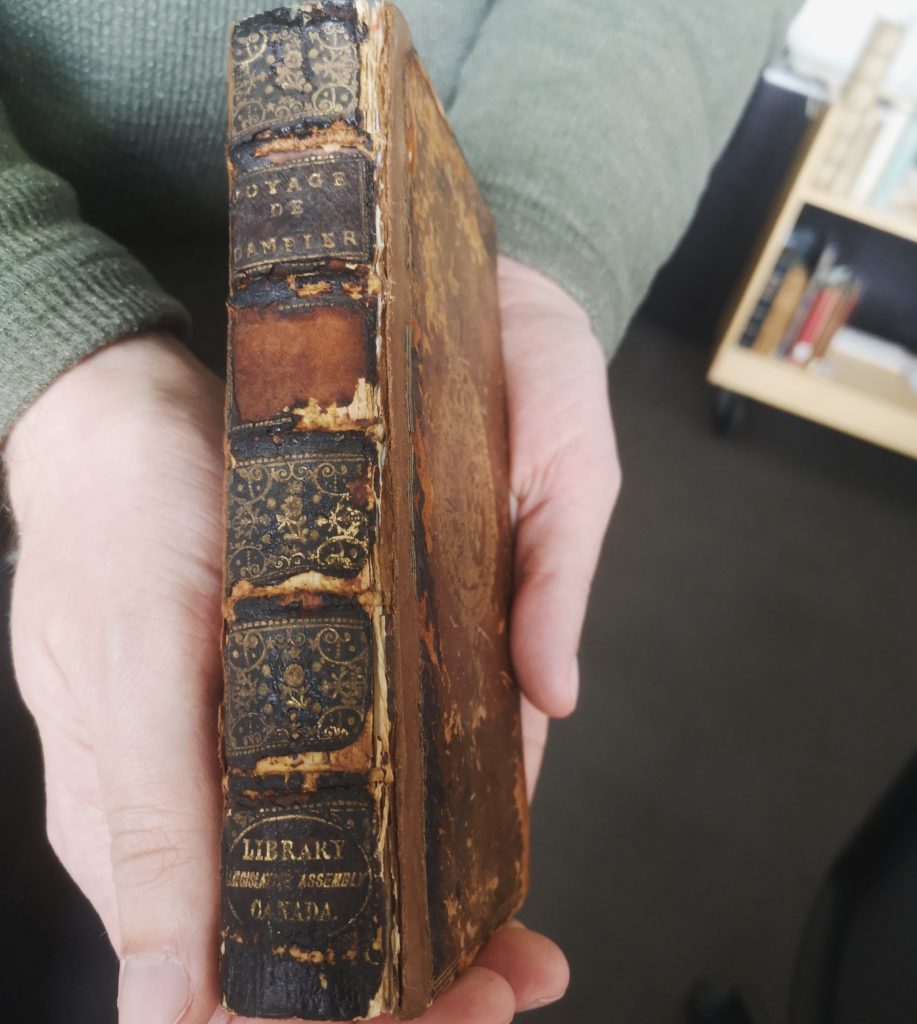
Hands hold charred copy of the "Voyages de Dampier" with binding side up
Fig. 2: Spine of the “Voyage de Dampier” showing considerable fire damage.

During the workshop, we discussed the contents of the books and their significance to Canadian history. The collection features books of reading lessons, a collection of short stories dated 1868-9 which were used to teach early Canadian children to read (Fig. 3). Items such as these are considered significant to Canadians for many reasons, including the history of education, the history of early Canadian printing, and more. Lucy Maud Montgomery’s novels are significant as an example of a female Canadian novelist. Provenance, including the origin and previous owners of a book, can be significant to Canadians as well: The copy of Xenophon’s Cyropaedia, as mentioned above, was previously owned by a relative of Amerigo Vespucci from whom the Americas were named. It was then housed and subsequently donated by the British government to the people of Canada in 1967 on the centennial of the confederation. (Fig. 4) These layers of meaning accrued through provenance transcend the contents of the book itself to have special importance to the people of Canada.

Second Book of Reading Lessons, volumes dated 1868 and 1869 / Second Book of Reading Lessons, volumes datés de 1868 et 1869

Fig. 3: Library and Archives Canada, Second Book of Reading Lessons, volumes dated 1868 and 1869 / Second Book of Reading Lessons, volumes datés de 1868 et 1869, Click on image to learn more (redirects to the LAC’s Flickr).

Cyropaedia [British Government bookplate and first page of text] / Cyropaedia [Première page de texte et ex libris du gouvernement britannique]

Fig. 4: Library and Archives Canada, Cyropaedia [British Government bookplate and first page of text] Cyropaedia [British Government bookplate and first page of text], Click on image to learn more (redirects to the LAC’s Flickr).

As a medievalist, what I found the most interesting throughout the workshop was the reoccurring theme of Canadians envoking the European Middle Ages. Through efforts such as the construction of Neo-Gothic architecture in Ottawa, the erection of statues depicting medieval characters and imagery, and in the rare books collected, it seems as though early Canadians were attempting to create an imagined Medieval past. Parliament Hill and the three buildings that compose it as well as the Notre-Dame Cathedral Basilica (1846) are examples of Neo-Gothic style. Pointed arches, stained-glass, sky-high pointed spires and exceptionally detailed decorations are some of the most iconic features of Gothic architecture that are shared with these buildings.

Late-day sun illuminates the two spires and facade of the Notre-Dame Cathedral Basilica in Ottawa
Fig. 5: Ottawa’s Notre-Dame Cathedral Basilica. The tall iron-laced windows and ornate spires are characteristic of Gothic style.

If you have ever walked by Parliament Hill, you may have noticed a medieval figure gallantly looking out over Wellington street. This statue is depicting none other than Sir Galahad, one of King Arthur’s knights of the round table (Fig. 3). But what is the stuff of Medieval legend doing outside Canada’s parliament building? Scanlon explains the piece was erected by William Mackenzie King in 1905 in honour of Henry Albert Harper, King’s close friend who died attempting to save a young girl who fell through the ice at the Governor General’s skating party in 1901. Despite the association between Sir Galahad and bravery, why did King make this choice? It is rumoured the choice may have come from Harper saying, “If I lose myself, I save myself” a line spoken by Sir Galahad in Tennyson’s The Holy Grail, moments before attempting the rescue. Whether or not this is true, Harper’s association with the knight runs deeper: he and King were immense fans of Tennyson’s Arthurian works and the two frequently discussed the tales. As the men were of British descent, it follows that these legends were part of their cultural awareness and the relationship between the Arthurian legends and nation building cannot be overlooked. Just as Geoffrey of Monmouth’s 1136 Histories of the Kings of Britain a pseudo-historical account of the foundation of Britain introduced the fabled King Arthur and his knights, it may have been King’s intention to evoke these characters once more in an effort to reaffirm the chivalry and bravery that he believed should characterise Canadians.
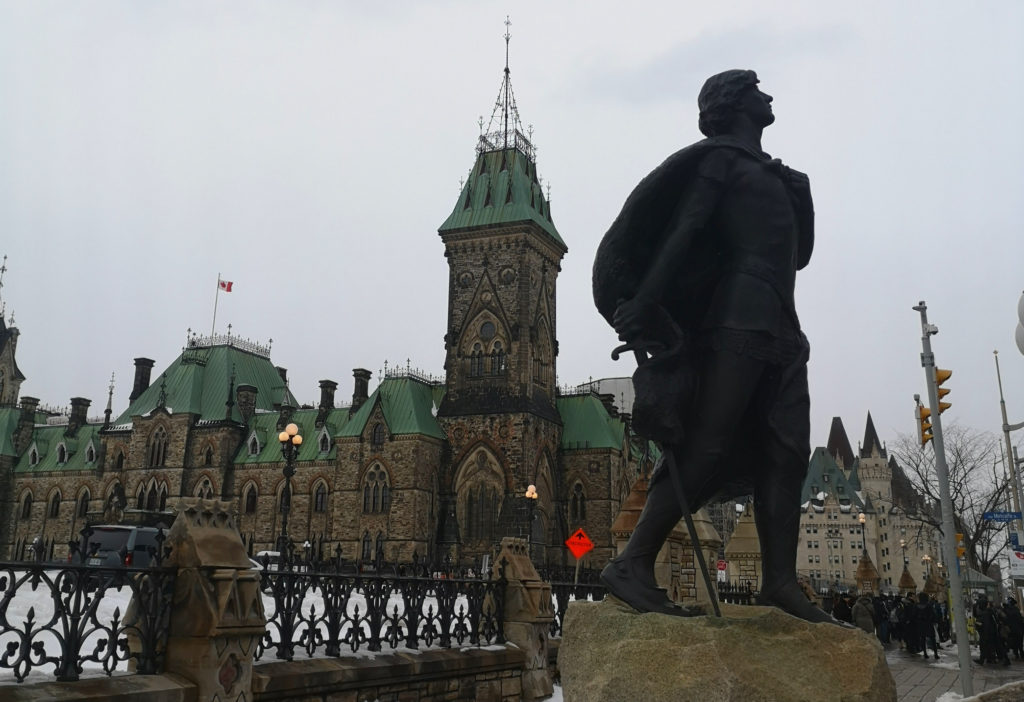
The statue of Galahad in front of Parliament Hill with parliament block building in background
Fig. 6: Statue of Galahad in front of Parliament Hill

We find evidence of Medieval influence in the books that make up the special collections. For instance, the aforementioned Cyropaedia is reinforced with vellum, which was the most widely used writing surface in the Middle Ages. The book also features an illuminated initial letter in red and blue ink meant to emulate those found in medieval manuscripts (Fig. 4). Perhaps even more pointedly, the LAC has a single leaf from the Gutenberg Bible in its collection (Fig. 7). This piece is not a work of Canadiana, so why does it belong in this collection? Despite the obvious importance it holds as one of the earliest ‘mass’ printed books and the contributions the Gutenberg press made to print culture, I believe this item belongs in this collection for another reason. By housing this item in a Canadian institution we closely link European cultural heritage to our own. As a former colony of England and France, a large part of Canadian identity comes from the shared history we have with many Europeans. Although Canada strives and embraces multiculturalism today, our European ties still remain a big part of our history.

A single leaf from an incomplete copy of the Gutenberg Bible /   Feuillet d’un exemplaire incomplet de la Bible de Gutenberg

Fig. 7: Library and Archives Canada, A single leaf from an incomplete copy of the Gutenberg Bible / Feuillet d’un exemplaire incomplet de la Bible de Gutenberg, Click on image to learn more (redirects to the LAC’s Flickr).

The journey through time that Scanlon presented in this workshop was enlightening. By demonstrating the importance of the book as a physical object we were able to see that many different items belong in the Canadian collection because so much of our heritage comes from different places, times, and people —explaining the prevalence of Medieval visual culture in Canada. From travel journals to children textbooks, and the first mass-printed bible to a textbook on organic chemistry, the seemingly eclectic becomes unified in the Library and Archives of Canada’s special and rare books collection.


Bibliographical Information

Bartleby: Great Books Online, Nicholson & Lee, eds. The Oxford Book of English Mystical Verse. 1917. Alfred, Lord Tennyson ‘The Holy Grail’. Accessed April 16, 2019. https://www.bartleby.com/236/96.html

Library and Archives Canada Flickr, Rare Books / Livres rares Album, Accessed April 15, 2019. rhttps://flic.kr/s/aHsjVUoUBX

Notre-Dame Cathedral Ottawa, History. Accessed April 16, 2019. https://notredameottawa.com/history

Roy Mayer, Ottawa Citizen, “Ottawa’s Forgotten Hero”, December 6, 2007. Accessed April 15, 2019. https://www.pressreader.com/canada/ottawa-citizen/20071206/281814279522761

University of Michigan Library, “P46: What is a Codex?”, Accessed April 17, 2019, https://www.lib.umich.edu/reading/Paul/codex.html
National Library and Archives Co-Lab Project: Crowd-sourcing Initiatives in the Canadian Government

Co-Lab is a tool initiated by the Government of Canada’s National Library and Archives (LAC) that allows crowd-sourcing transcriptions, tags, translations, and descriptions on digitized sources. The LAC explains the key motivations for the project were to increase the accessibility of these documents to researchers by making the images highly searchable, and to the visually impaired by allowing these images to be read by screen-readers.

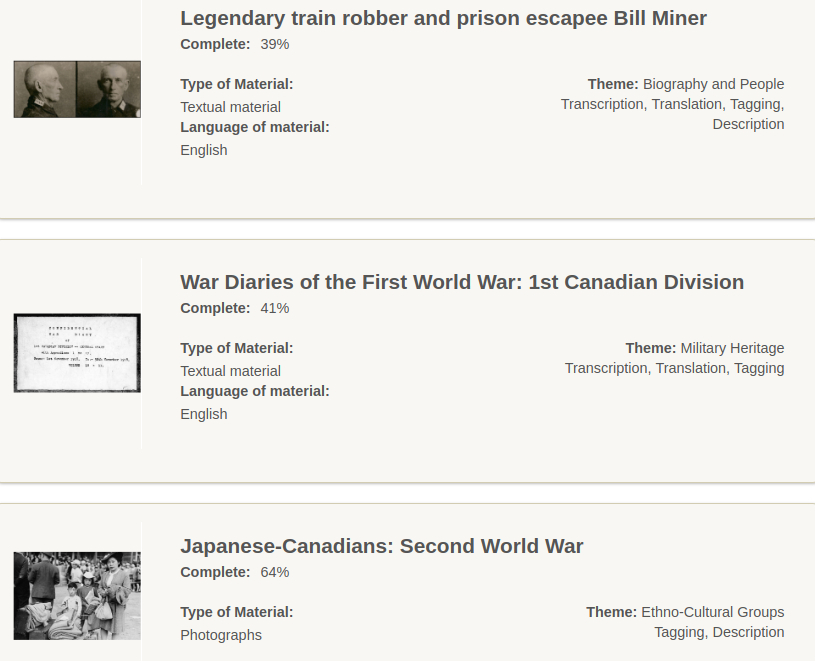
The process to digitize items is labour intensive and notoriously slow, therefore the LAC must carefully choose what to digitize and, importantly, when. Many of these items were deliberately chosen to coincide with their centennial anniversaries, a common milestone for the Canadian government to commemorate. These include the “Spanish Flu Pandemic of 1918-1919” project, which included 117 images to transcribe and has since been completed. Similarly, “The Call to Duty: Canada’s Nursing Sisters” and “War Diaries of the First World War: 1st Canadian Division” commemorate the end of World War I. Others were chosen for their remarkable content, usually original photos and exceptional experiences: “Rosemary Gilliat (Eaton)’s Arctic diary and photographs”, “Japanese-Canadians: Second World War” and “Legendary train robber and prison escapee Bill Miner” and examples of this.

Screen shot of the "Challenges" page on the LAC website
Screen shot, Library and Archives Canada. (2019). Co-Lab: Challenges. Retrieved from: https://colab.baclac.gc.ca/eng/Challenges

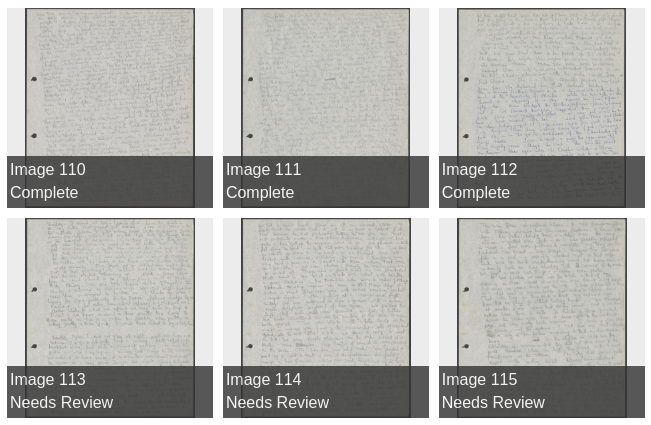
The LAC titles these projects as “Challenges” and asks the public to crowd-source various types of data (bottom right corner in above image) that is needed for the challenge to be completed. These include, as seen above: tagging, transcriptions, translations (English to French; French to English), and descriptions. The process is simple enough, once a user has provided the required data, they manually mark the image or scan as “completed”, “needs review”, or “incomplete” so that the next users can identify the status of an item in the larger challenge. The image below depicts what this looks like from the item overview:

Screen shot from the LAC item outline
Screenshot of Rosemary Gilliat’s Arctic diary: Collection’s Overview. Library and Archives Canada. (2019). Co-Lab: Rosemary Gilliat (Eaton)’s Arctic diary. Retrieved from:
https://co-lab.bac-lac.gc.ca/eng/Tasks/Details/1015

So what does this process look like? I encourage you to click on the image above and select an item to follow along with. For now, an incomplete task page looks like this:

Screenshot of Canvas: Image 215. Library and Archives Canada. (2019). Co-Lab: Rosemary Gilliat (Eaton)’s Arctic diary: Image 215. Retrieved from: https://co-lab.bac-lac.gc.ca/eng/Objects/Contribute/e011181043-215?gid=1015

Note the transcription area (right of scan) is blank. The transcription status is set to “Not Started”. Both of these elements are community contributed content and are largely unmoderated. That is, the general population is encourage to add, edit, and moderate this content themselves. Clearly, the pessimists among us will already see the issue: what if one user, intentionally or unintentionally, deletes or falsifies this data? What mechanisms are in place to ensure crowd sourcing goes as planned? The answer, somewhat strangely, is that there is none. Surely a user would be shamed into not intentionally participating in erroneous behaviour, but, the website allows users to contribute anonymously, removing that element. Thus, the mechanism is the contributing population itself. It is a self-regulating community. But I suspect there is more to it than this. The project is by no means public knowledge, and I believe that the platform benefits from this lack of knowledge. Unlike similar community contribution run websites such as Reddit, a widely used collection of forums that allow millions to engage with content from across the web daily, LAC’s Co-Lab project enjoys a more obscure status, lending itself to the academic community rather than the general population. So, where we get the infamous “internet trolls” on popular sites (see YouTube, Facebook), the relative anonymity of the Co-Lab project allows for a smoother, but perhaps slower, process of crowd-sourcing data.

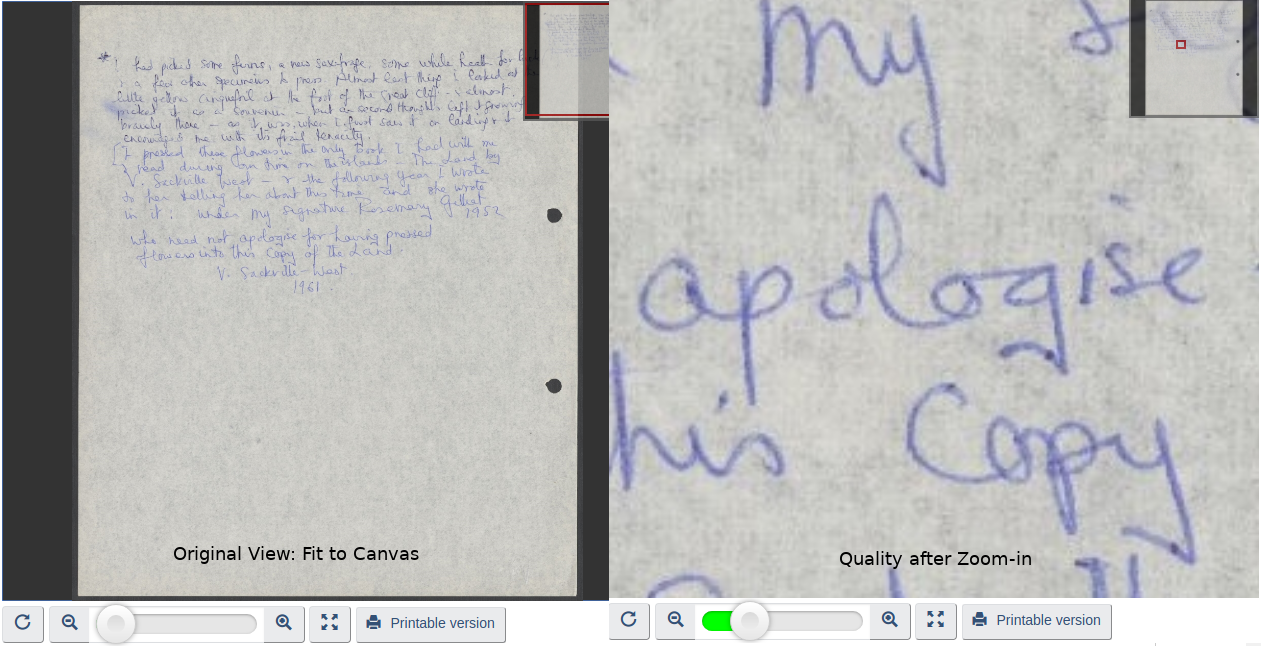
Now that the contributor has situated themselves with the image and transcription box, they can begin to transcribe. The LAC has implemented an OpenSeadragon viewer to allow for high resolution zoom-ins of the items for easier transcription. It looks like this:

Juxtaposed two screenshots of Canvas: Image 215. Library and Archives Canada. (2019). Co-Lab: Rosemary Gilliat (Eaton)’s Arctic diary: Image 215. Retrieved from: https://co-lab.bac-lac.gc.ca/eng/Objects/Contribute/e011181043-215?gid=1015

Instantly one can see the benefit of this tool for transcription. The zoom allows you to see the letter forms up close and with high definition, allowing the transcriber to leave their magnifying glass at the door. The benefit of OpenSeadragon over another zoom tool is that it only renders the requested segment of the image. This means the user only downloads the information for a small piece of the entire canvas at a time, reducing loading time while still allowing for incredibly high resolution zooms. This increases accessibility to all Co-Lab users, even those on machines with low processing specs or those with slow internet connections.

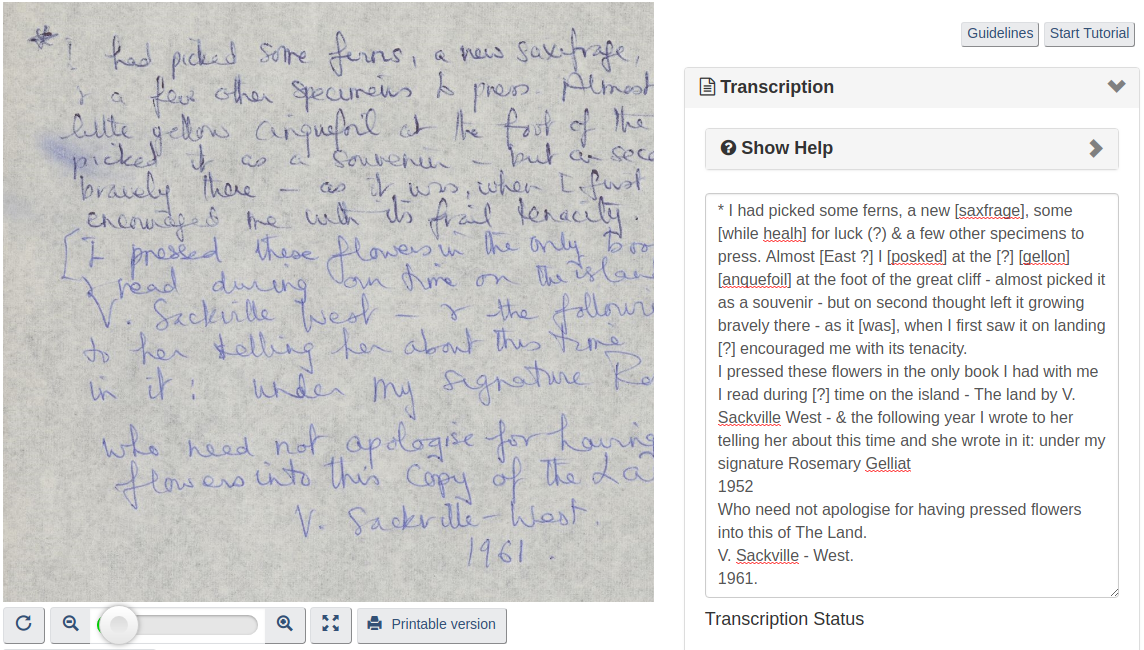
Having discussed the framework, it was time to begin the process of transcription. Continuing with Image 215, I transcribed the manuscript the way I was trained. The result below took about five minutes to accomplish:

Screenshot of Canvas: Image 215. Library and Archives Canada. (2019). Co-Lab: Rosemary Gilliat (Eaton)’s Arctic diary: Image 215. Retrieved from: https://co-lab.bac-lac.gc.ca/eng/Objects/Contribute/e011181043-215?gid=1015

But LAC has outlined guidelines for transcription that do not necessarily follow the training I have received. I compared the guidelines, and found several places that needed adjustment in order to properly contribute to the project, chiefly:

  • Indicate words that you are unsure of by using the term “illegible” or a question mark inside two sets of square brackets. Example: [[illegible]] or [[?]].
  • If you can decipher a portion of the word, include it followed by a question mark inside two sets of square brackets. Example: [[immediate?]], [[-ing?]], [[name?]], etc.
  • […]
  • Do not worry about the formatting, such as text alignment, columns, line breaks, spacing, etc.
        —from: Co-Lab, Guidelines, Transcription Guidelines

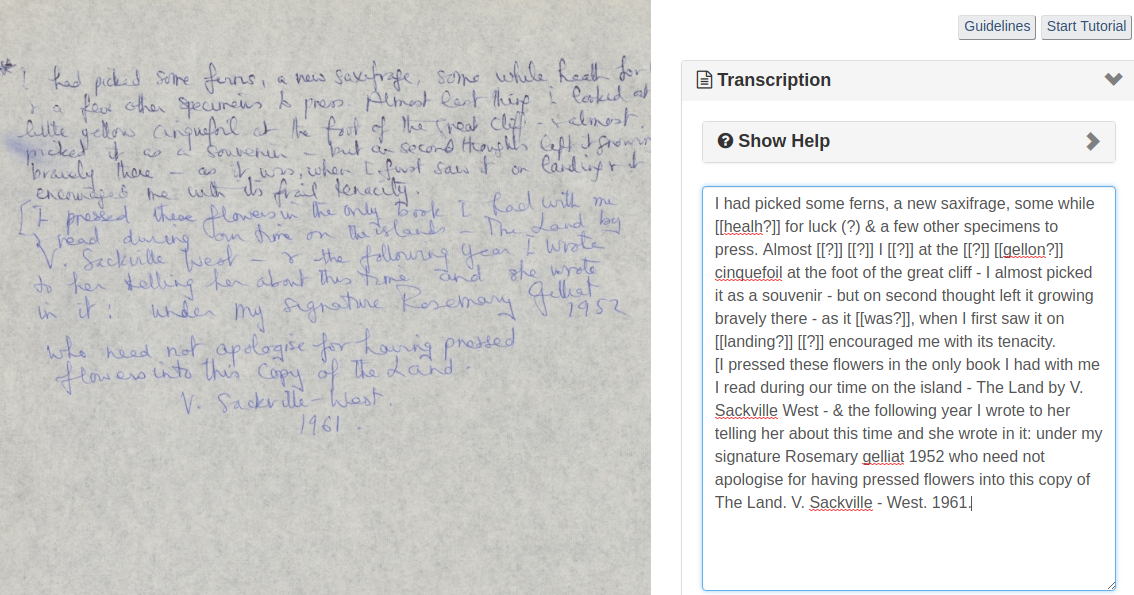
After fixing these issues to more closely fit the guidelines of the Co-Lab project, the transcription looked like this:

Screenshot of Canvas: Image 215. Library and Archives Canada. (2019). Co-Lab: Rosemary Gilliat (Eaton)’s Arctic diary: Image 215. Retrieved from: https://co-lab.bac-lac.gc.ca/eng/Objects/Contribute/e011181043-215?gid=1015

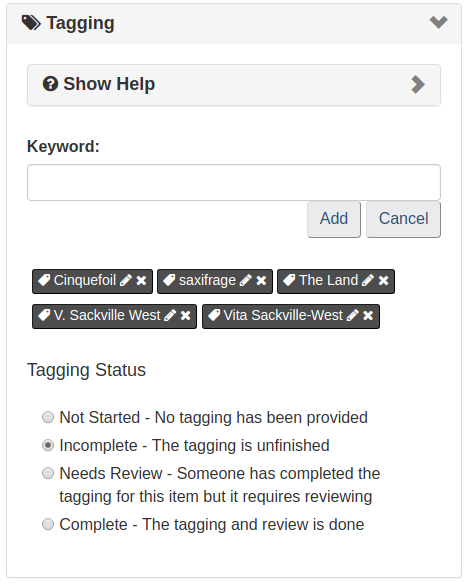
In the process, I was able to research and correctly identify a few of the words such as “saxifrage” and “cinquefoil”. I changed the status of the transcription from “Incomplete” to “Needs Review” and provided some appropriate tags:

Detail from Co-Lab sidebar on Image 215. Library and Archives Canada. (2019). Co-Lab: Rosemary Gilliat (Eaton)’s Arctic diary: Image 215. Retrieved from: https://co-lab.bac-lac.gc.ca/eng/Objects/Contribute/e011181043-215?gid=1015

Altogether, the process to contribute to these challenges was made easy by the guidelines and tutorials provided by Co-Lab. The implementation of the OpenSeadragon viewer gives access to anyone with access to a computer and an internet connection. Despite this, it is not widely popular, a fact that I believe helps Co-Lab reach its crowd-sourcing goal more than it hinders. The LAC put forth these challenges in order to both provide the public full digital access to these interesting pieces of history and have them transcribed, tagged, translated, and described by those same people. Had a department (or a single researcher) in the LAC been in charge of providing this same data, the process would have likely taken years, or perhaps these items may have never made it to the digitization lab. This crowd-sourcing endeavour demonstrates the living nature of historical documents and images, and gives shared authority and access to the public. I am eager to see where the LAC’s Co-Lab project goes next.


Works Cited & Web Resources

Cataloguing Medieval Manuscripts. (2013). Crowdsourcing the Arcane: Utilizing Flickr (and Google) to Describe Medieval Manuscript Fragments. Retrieved from:
https://micahcapstone.wordpress.com/category/uncategorized/
Accessed to get a quick understanding of the process and trials of similar crowdsourcing projects.

Library and Archives Canada. (2019). Co-Lab: Your Collaboration Tool. Retrieved from:
https://co-lab.bac-lac.gc.ca/eng

Library and Archives Canada. (2019). Co-Lab: About Co-Lab. Retrieved from:
https://co-lab.bac-lac.gc.ca/eng/About

Library and Archives Canada. (2019). Co-Lab: Challenges. Retrieved from:
https://co-lab.bac-lac.gc.ca/eng/Challenges

Library and Archives Canada. (2019). Co-Lab: Rosemary Gilliat (Eaton)’s Arctic diary and photographs. Retrieved from:
https://co-lab.bac-lac.gc.ca/eng/Challenges/Details/1009

Library and Archives Canada. (2019). Co-Lab: Rosemary Gilliat (Eaton)’s Arctic diary. Retrieved from:
https://co-lab.bac-lac.gc.ca/eng/Tasks/Details/1015

Library and Archives Canada. (2019). Co-Lab: Rosemary Gilliat (Eaton)’s Arctic diary: Image 215. Retrieved from:
https://co-lab.bac-lac.gc.ca/eng/Objects/Contribute/e011181043-215?gid=1015

OpenSeadragon. (2013). OpenSeadragon 4.2.0. Retrieved from:
https://openseadragon.github.io/


Working with Omeka(.net)

Today my task was to install and begin to understand how to use Omeka classic, a tool for creating digital collections and exhibitions. I was concerned about usability (would students be able to learn to use this quickly and efficiently?) and whether or not Omeka’s exhibit feature could easily display the information suited to medieval materials.

Which Omeka?

When you first decide to work with Omeka you are presented with a few different options. First, you are presented with two different versions of Omeka. Omeka Classic and Omeka S. The site describes Omeka S as “a shareable resource pool” that can be used by institution that want to manage their content across multiple sites. Since our task in the Medieval Book is to create a stand-alone digital catalogue project, I decided to use Omeka Classic.

The next question is Omeka.org or Omeka.net? If you already have the available server space, Omeka.org is there to download for free and to start working with right away. If you’re not ready to jump in yet, (like I wasn’t, preferring to first see what potential this platform had) I would recommend the free trial 1-site option despite its limitations: you only have access to 500 MB of storage space and just a few choices of plugins.

Populating the Database

The first thing that is necessary to do is create your collections and begin to add items to them. To keep it simple I created two collections: Carleton University Archives and Research Collection and Carleton University Art Gallery Collection. To make sure I did not go over my space allocation I could not add all the items, but added two items to each collection for testing.

The Exhibition Plugin

Once my database had some items in its collections, it was time to figure out how to display my artifacts. The exhibition feature of Omeka is a plugin that must be installed in order to use. After entering some information on the Exhibit (Title, slug, credits, description) and selecting your Theme (I stuck with the default, Berlin) you’re ready to start creating Exhibit pages. This part was straight-forward. You simply click “Add Page” and it will bring you to a new page where you input the title and slug and get started on the content. Since I already uploaded my files, this part was simple.

You begin by selecting how you want your content to be displayed. Only two give you the option to display both text and images (File with Text and Gallery). I tried one of each to test out the differences. In the end, they essentially give you nearly the same result with the exception of how the images are displayed. In File with Text, the images are displayed quite large whereas Gallery displays them as thumbnails. I plan to explore the plugins that are available to see if there are more ways to display the information that are more intuitive to manuscripts.

My thoughts on Omeka so far

In Omeka I see a large capacity for growth. Although the trial website is limited, it allows you to create a database and exhibit in a fairly intuitive way. Anything that is not intuitive is well documented either by the creators of Omeka or through the user community. For the display of medieval materials however, I see several problems. For one, the Dublin Core metadata element set is very general. Few of the elements are important data for medieval content, and there are many key data elements for medieval content (location, script, and shelfmark, etc) that are absent. In an effort to fix this issue I explored plugins that might expand this restrictive element set. I found LC Suggestion plugin that expands on the default element set, but does not tailor well to medieval content.

There is still so much to learn about Omeka and loads of plugins and features to explore. My next task will be to find online exhibitions that used Omeka (and others that did not) that host medieval artifacts and understand what can be done to accomplish our exhibition.


See what I accomplished with the Omeka free-trial here.